
DECENTRALIZED PRIVACY SOLUTIONS FOR BIG DATA: THE PROMISE OF DISTRIBUTED LEDGER TECHNOLOGIES
- Authors
-
-
Dr. Saad Ahmed
Department of Computer Science, National University of Sciences and Technology (NUST), Islamabad, Pakistan
-
- Keywords:
- Distributed Ledger Technology (DLT), Decentralized Privacy, Big Data Security, Blockchain
- Abstract
-
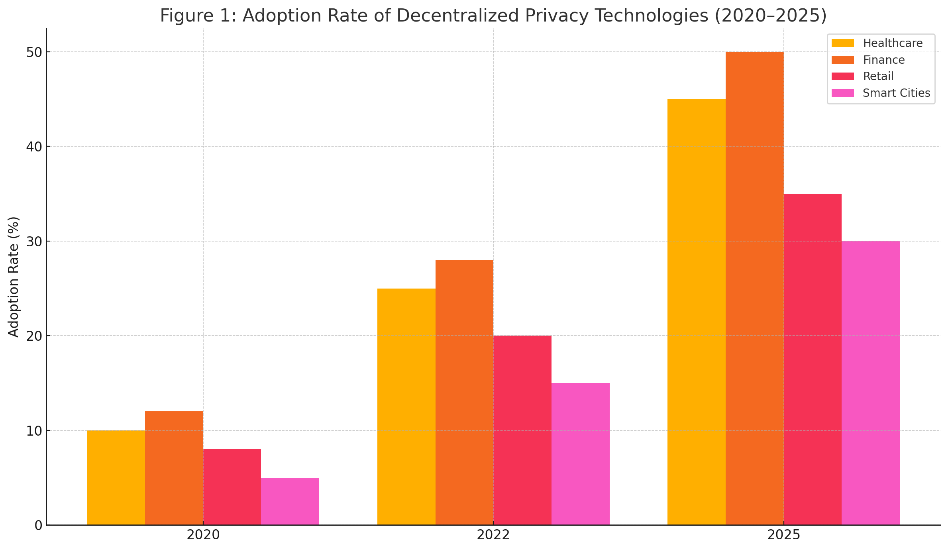
The exponential growth of Big Data has heightened concerns surrounding privacy, security, and data ownership. Traditional centralized models often struggle to provide scalable and resilient privacy assurances. Distributed Ledger Technologies (DLTs) such as blockchain offer decentralized frameworks that enhance privacy, integrity, and control over Big Data assets. This article explores the potential of decentralized privacy solutions by examining the integration of DLTs into Big Data ecosystems. We discuss emerging frameworks, key technological innovations, and challenges in adoption. Graphical analysis further highlights trends in adoption and security improvements.
- Downloads
-
Download data is not yet available.
- References
-
Davis, F. D. (1989). Perceived usefulness, perceived ease of use, and user acceptance of information technology. MIS Quarterly, 13(3), 319–340. https://doi.org/10.2307/249008
Sohail, N., Haque, A., Aziz, S., & Maruf, T. I. (2023). Impact of diffusion of innovation among Pakistani consumers’ adoption of halal cosmetics. *South East Asia Journal of Contemporary Business, Economics and Law, 30*(2), 39–49. ISSN 2289-1560.
- Cover Image
-
- Downloads
- Published
- 2023-06-30
- Section
- Articles
- License
-
Copyright (c) 2023 Dr. Saad Ahmed

This work is licensed under a Creative Commons Attribution 4.0 International License.
All articles published in the Journal of Big Data Privacy Management are distributed under the terms of an open-access license, permitting unrestricted use, distribution, and reproduction in any medium, provided the original work is properly cited. Authors retain copyright of their work and grant the journal the right of first publication. The journal promotes transparency, accessibility, and global dissemination of research findings.
