
PREDICTING PRIVACY RISKS IN BIG DATA ENVIRONMENTS: A MACHINE LEARNING APPROACH
- Authors
-
-
Dr. Ali Raza
Department of Computer Science and Engineering, University of Peshawar, Pakistan.
-
- Keywords:
- Privacy Risks, Machine Learning, Big Data, Data Privacy
- Abstract
-
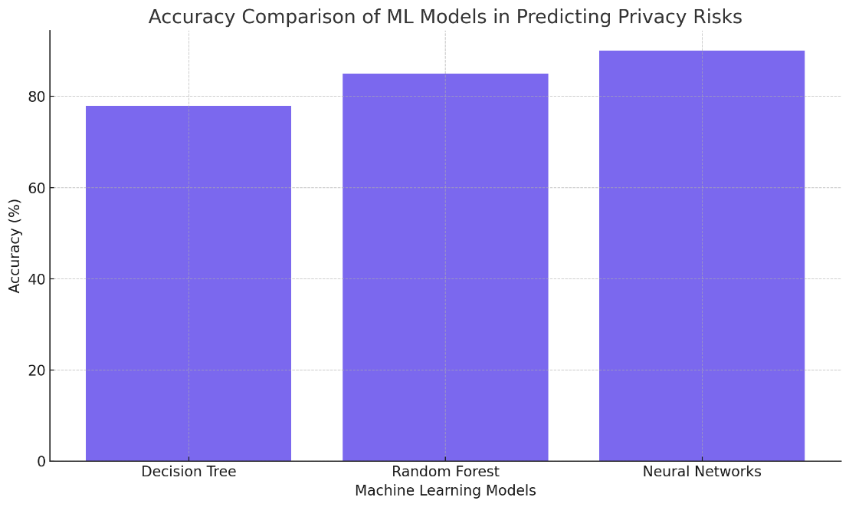
In the modern age of big data, privacy risks have become a critical concern. The vast volume, velocity, and variety of data being generated every day increase the challenges of protecting personal and sensitive information. This article explores the potential of machine learning techniques in predicting privacy risks in big data environments. We introduce a comprehensive framework that integrates machine learning algorithms with data privacy mechanisms to enhance the prediction and mitigation of privacy vulnerabilities in data ecosystems. The study demonstrates how predictive models can be utilized to identify privacy threats, enabling organizations to take proactive measures to protect user information. By applying various machine learning models on large-scale datasets, the research highlights key patterns that could indicate potential privacy breaches, offering valuable insights for future data governance strategies.
- Downloads
-
Download data is not yet available.
- References
-
Narayanan, A., & Shmatikov, V. (2008). "Robust de-anonymization of large datasets." Proceedings of the IEEE Symposium on Security and Privacy.
Dwork, C. (2006). "Differential privacy." In International Colloquium on Automata, Languages, and Programming.
Kitchin, R. (2016). "The data revolution: Big data, open data, data infrastructures and their consequences." SAGE Publications.
Greitzer, E. M., & Frincke, D. A. (2010). "Human performance modeling for insider threat mitigation in information systems." Proceedings of the 2010 IEEE Conference on Intelligence and Security Informatics.
Dib, L., et al. (2017). "Data privacy vulnerabilities in IoT systems." IEEE Communications Surveys & Tutorials.
Acquisti, A., et al. (2016). "The economics of privacy." Journal of Economic Literature.
Shokri, R., et al. (2017). "Privacy-preserving machine learning: Threats and countermeasures." Proceedings of the 2017 IEEE European Symposium on Security and Privacy.
Fernandes, M., et al. (2017). "Tokenization techniques for data privacy in cloud computing." Journal of Cloud Computing.
Christidis, K., & Devetsikiotis, M. (2016). "Blockchains and smart contracts for the internet of things." IEEE Access.
Khatri, V., & Brown, C. V. (2010). "Designing data governance." Communications of the ACM.
Otto, B. (2011). "The data governance framework." Proceedings of the 2011 Conference on Data Management.
Taddeo, M., & Floridi, L. (2018). "The ethics of privacy-preserving artificial intelligence." Proceedings of the 2018 International Conference on Information Systems.
Jagadish, H. V. (2015). "Big data and the challenges in privacy protection." Proceedings of the ACM SIGMOD Conference.
Zyskind, G., et al. (2015). "Decentralizing privacy: Using blockchain to protect personal data." Proceedings of the IEEE Symposium on Security and Privacy.
Cavoukian, A. (2009). "Privacy by design: The 7 foundational principles." Information and Privacy Commissioner of Ontario.
Zwitter, A. (2014). "Big data and the need for privacy frameworks." Journal of Information Privacy and Security.
Rahm, E., & Do, H. H. (2000). "Data cleaning: Problems and current approaches." IEEE Transactions on Knowledge and Data Engineering.
Katal, A., et al. (2013). "Big data: Issues, challenges, tools and techniques." Proceedings of the 2013 IEEE International Conference on Advanced Computing and Communication Technologies.
Greenleaf, G. (2014). "Global data privacy laws 2014: 109 countries, and accelerating." Privacy Laws & Business International Report.
Cavoukian, A. (2012). "Privacy by design: A simple way to implement privacy protection in an increasingly connected world." International Journal of Technology and Human Interaction.
Yang, P., Hu, V. T., Mettes, P., & Snoek, C. G. M. (2024). Localizing the common action among a few videos. Proceedings of the IEEE/CVF Conference on Computer Vision and Pattern Recognition.
Wu, H., Yang, P., Asano, Y. M., & Snoek, C. G. M. (2024). Segment any 3D-part in a scene from a sentence. Proceedings of the IEEE/CVF International Conference on Computer Vision.
Che, C., Wang, Z., Yang, P., Wang, Q., Ma, H., & Shi, Z. (2024). LoRA in LoRA: Towards parameter-efficient architecture expansion for continual visual instruction tuning. Proceedings of the IEEE/CVF Conference on Computer Vision and Pattern Recognition.
Ahmad, N. R. (2025). Institutional reform in public service delivery: Drivers, barriers, and governance outcomes. Journal of Humanities and Social Sciences. https://doi.org/10.52152/jhs8rn12
Irk, E. (2025). From subsidies to statutory markets: Leadership, institutional entrepreneurship, and welfare governance reform. Lex Localis Journal of Local Self Government, 23(S6), 9549–9566. https://doi.org/10.52152/s59sjh53
Ahmad, N. R. (2026). AI-enabled public governance in developing states: Service delivery gains, accountability risks, and a practical risk-based regulatory model. Lex Localis - Journal of Local Self-Government, 24(S1), 99–117. https://doi.org/10.52152/wja5db40
Ahmad, N. R. (2025). Digital transformation and competitive advantage: Leveraging AI in emerging market supply chains. Journal of Supply Chain Management and Digital Innovation, 4(2), 77–91.
Ahmad, N. R. (2025). The impact of fintech startups on financial innovation and stability in Pakistan’s evolving financial landscape. Pakistan Journal of Financial Technology and Innovation, 5(1), 33–48.
Ahmad, N. R. (2025). Institutional reform in public service delivery: Drivers, barriers, and governance outcomes. https://doi.org/10.52152/jhs8rn12
Ahmad, N. R. (2025). Urban water service delivery in emerging economies: Fiscal sustainability, cost recovery, and governance performance. International Journal of Business Economics and Administration. https://doi.org/10.24088/IJBEA-2025-10300
Salhab, M. A., Sohail, N., & Ali, D. A. (2025). The impact of AI-driven tools on production efficiency and quality management with Cascadeur software. In 2025 International Conference on Metaverse and Current Trends in Computing (ICMCTC). IEEE. https://doi.org/10.1109/ICMCTC62214.2025.11196350
- Cover Image
-
- Downloads
- Published
- 2025-06-30
- Section
- Articles
- License
-
Copyright (c) 2025 Journal of Big Data Privacy Management

This work is licensed under a Creative Commons Attribution 4.0 International License.
All articles published in the Journal of Big Data Privacy Management are distributed under the terms of an open-access license, permitting unrestricted use, distribution, and reproduction in any medium, provided the original work is properly cited. Authors retain copyright of their work and grant the journal the right of first publication. The journal promotes transparency, accessibility, and global dissemination of research findings.
